Puredyne® printhead helps researchers improve reproducibility and shape fidelity in extrusion-based bioprinting
Extrusion-based 3D bioprinting has become an important tool for regenerative medicine and tissue engineering, enabling the fabrication of complex three-dimensional structures for biomedical research. However, processing advanced biomaterials often presents significant challenges, particularly when precise and reproducible material deposition is required.
To address these challenges, researchers at the Biomaterials and Biofabrication Laboratory at École de technologie supérieure (ÉTS) in Montreal integrated a Puredyne® printhead into their existing bioprinting platform. The objective of the project is to improve printing precision and reproducibility while gaining deeper insight into the influence of dispensing behavior on the quality of bioprinted structures.
The research is led by Professor Ali Ahmadi, with Professor Sophie Lerouge serving as co-principal investigator. PhD student Sara Badr has played a key role throughout the project, contributing to biomaterial development, print process integration, and experimental validation.
Working with demanding biomaterials
The team’s work focuses on foam hydrogels, a promising class of biomaterials for tissue engineering and regenerative medicine. Their porous architecture can facilitate oxygen and nutrient transport while creating a favorable environment for cell growth and tissue development.
At the same time, these materials exhibit complex viscoelastic behavior, making them particularly difficult to process consistently. Small variations in material flow can significantly affect filament placement and ultimately influence the geometry and quality of the printed construct.
For the researchers, these characteristics make foam hydrogels an ideal model system for evaluating advanced dispensing technologies.
Integrating precision dispensing into an existing platform
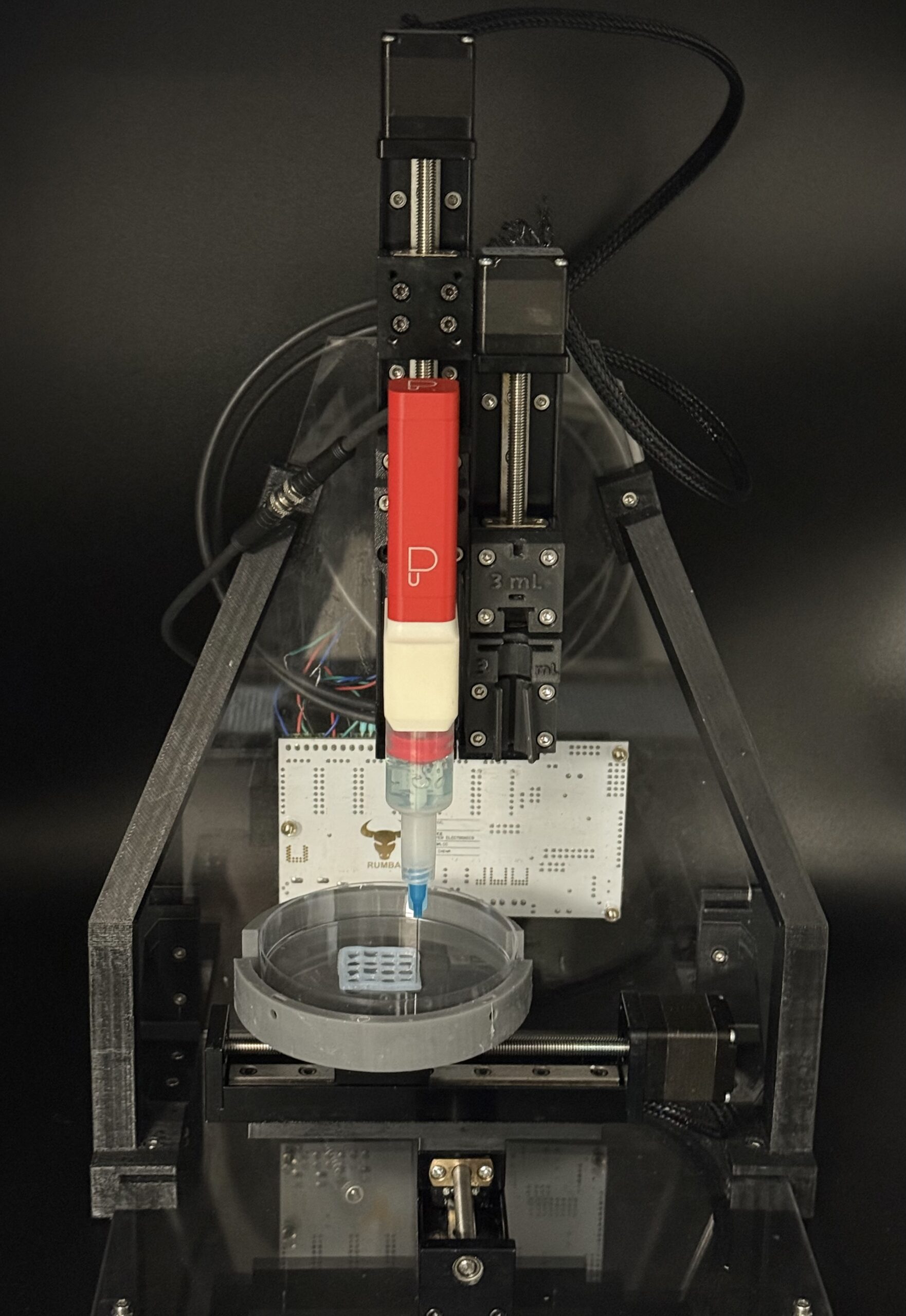
Rather than developing an entirely new bioprinting system, the research team integrated the Puredyne® printhead into its established platform. Achieving this required both mechanical and software adaptations.
A custom mounting system was designed and manufactured using 3D printing technology to securely install the printhead. In parallel, additional software routines were developed to enable communication and control through the printer’s existing operating environment.
According to the researchers, one of the most critical objectives was the ability to precisely initiate and terminate material flow during printing. Conventional extrusion approaches can struggle with unwanted material release after deposition, especially when processing highly viscoelastic formulations. This effect can negatively impact printing accuracy and reduce agreement between the digital design and the final structure.
Unlike pressure-driven extrusion systems, the Puredyne® printhead uses progressive cavity technology to control material displacement volumetrically. Designed for low-shear, pulsation-free dispensing across a broad viscosity range, it provides highly repeatable material delivery with controlled flow initiation and termination, helping reduce unwanted material release between printing movements.
Improving deposition accuracy
The integration of the Puredyne® printhead has already delivered encouraging results. Although formal quantitative benchmarking is still underway, the team has observed cleaner flow initiation and termination, reduced post-extrusion flow, and improved placement of deposited filaments.
These improvements have translated into better agreement between designed and printed scaffold geometries, resulting in higher shape fidelity and more reproducible printing outcomes.
“Consistent flow control is critical in bioprinting. The Puredyne® printhead gives us cleaner starts and stops, improving filament placement and helping the printed construct more closely match its digital design.” Sara Badr, PhD Student, Biomaterials and Biofabrication Laboratory, ÉTS.
Beyond the observed performance improvements, the project highlighted the importance of dispensing dynamics in bioprinting applications. The researchers found that the way material flow is controlled, particularly during the transition between extrusion and non-extrusion phases, has a significant impact on printing accuracy when processing foam and other viscoelastic hydrogels.
Relevance beyond the research laboratory
For ÉTS, the integration of the Puredyne® printhead expands the laboratory’s ability to investigate biomaterials that place particularly high demands on flow stability and dispensing accuracy. The improved process control also creates a more robust platform for future biofabrication research.
At the same time, the project demonstrates how industrial precision-dispensing technology can be successfully adapted to emerging biomedical applications. As biofabrication continues to evolve toward increasingly complex materials and structures, reliable material deposition is expected to play a key role in ensuring process consistency and product quality. The project also illustrates how a precision printhead can be integrated into an existing bioprinting platform. And it highlights potential applications for precision dispensing technology in laboratory automation, advanced biofabrication, and future biomedical manufacturing processes.
Next steps
Building on the initial results, the researchers plan to evaluate a broader range of biomaterials, including cell-laden hydrogels. Future work will focus on quantitatively assessing printing accuracy and repeatability, investigating biocompatibility and cell viability, and exploring the fabrication of larger and more complex three-dimensional constructs. Testing with cell-laden materials will assess how low-shear dispensing supports the desired printing performance while maintaining cell viability.
As the project progresses, the team expects to further evaluate how precise flow control can support more reliable and scalable bioprinting processes for future biomedical applications.